


Don't just test. Verify the specimen. Protect workplace safety.
Workplace safety requires more than a laboratory result. It requires confidence that the specimen tested actually belongs to the right person and the right testing procedure.
For over 20 years, RUMA has been developing patented security and verification technologies for regulated processes. The patented RUMA Digital-System links the individual, the authorised testing procedure and the laboratory specimen in a verifiable, secure process.
This eliminates the need for staff-intensive direct observation during specimen collection. Verification is secured through the individual marker and the documented testing procedure. This reduces the burden on specialist staff, simplifies organisation and allows more flexible testing arrangements – without compromising security.
Key Benefits
- Greater workplace safety – decisions are based on specimens that have been reliably attributed to the correct individual and verified.
- No staff-intensive direct observation – less supervision and fewer personnel resources required.
- Authenticated specimens – verification covers not only the laboratory result but also the origin of the specimen.
- Greater resistance to manipulation – specimen substitution, the use of someone else's urine and common attempts to circumvent testing are made considerably more difficult.
- More reliable decisions – particularly relevant for safety-critical activities and sensitive occupational health assessments.
- Less disruption to operations – more flexible testing with less travel, waiting time and organisational effort.
- Suitable for geographically dispersed workforces – across multiple locations, field operations and mobile employees.
- Existing infrastructure remains in place – laboratories, occupational health assessments and established testing procedures continue unchanged.
- An additional layer of verification – RUMA closes the gap between the person being tested and the specimen analysed in the laboratory.
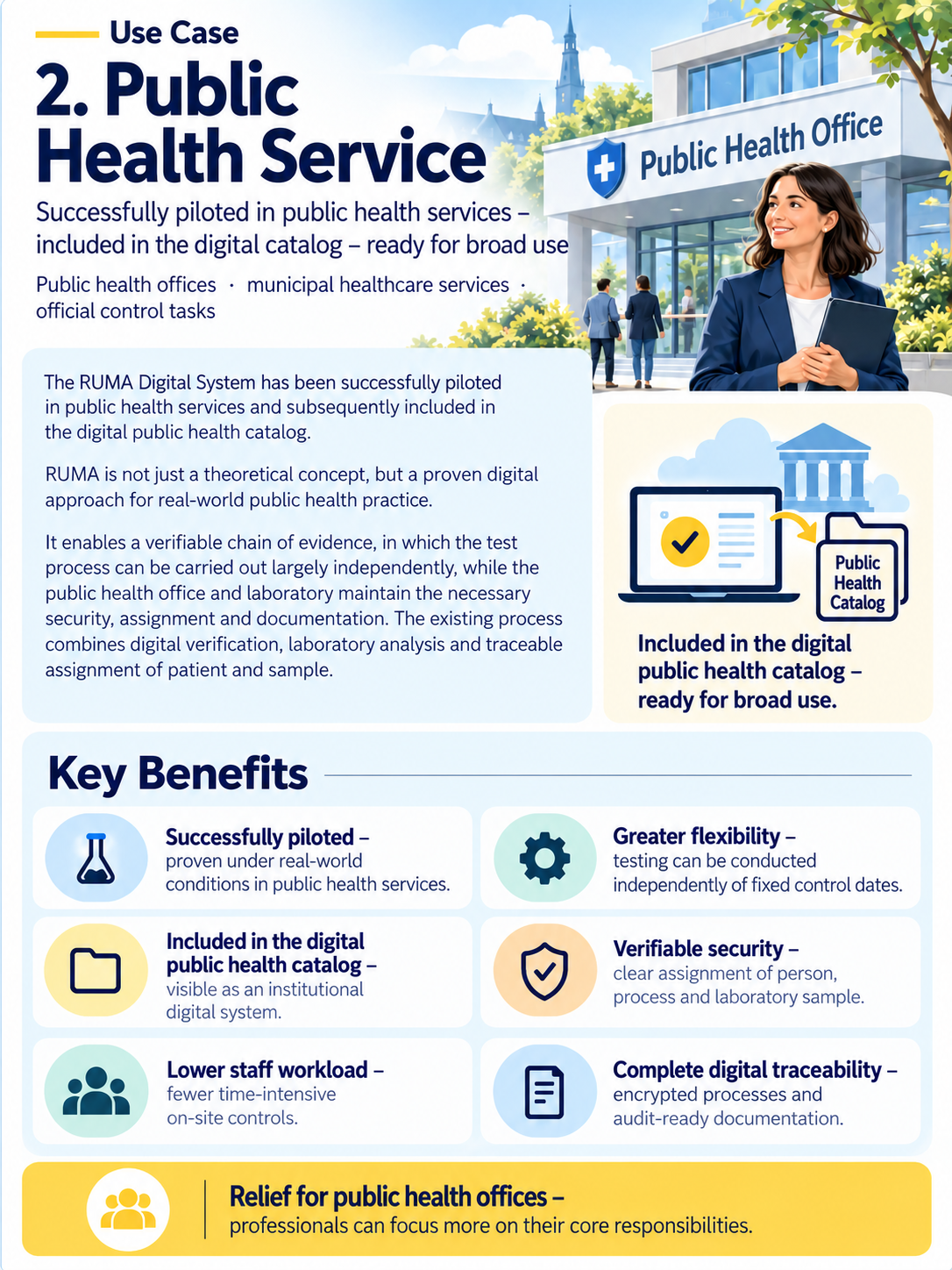
Piloted in Germany's Public Health Service (ÖGD) – Included in the Digital ÖGD Catalogue – Ready for Wider Deployment
Public health authorities · Municipal healthcare services · Official monitoring responsibilities
The RUMA Digital-System has been successfully piloted for use in Germany's Public Health Service (Öffentlicher Gesundheitsdienst, ÖGD) and subsequently included in the Digital ÖGD Catalogue.
RUMA is therefore more than a theoretical solution: it is a digital procedure that has already been tested in public health practice.
It enables a verifiable process in which individuals can largely carry out the required steps independently, while public health authorities and laboratories retain the necessary security, reliable attribution and documentation. The established process combines digital verification, laboratory analysis and traceable attribution of the specimen to the patient.
Key Benefits
- Successfully piloted – already tested under real-world conditions within Germany's Public Health Service.
- Included in the Digital ÖGD Catalogue – recognised as a digital system within the institutional framework.
- Reduced staffing requirements – fewer time-consuming on-site checks.
- Greater flexibility – procedures can be carried out independently of fixed verification appointments.
- Verifiable security – clear attribution of the individual, the procedure and the laboratory specimen.
- Digital traceability – encrypted processes and audit-ready documentation.
- Reduced workload for public health authorities – allowing specialist staff to focus more closely on their core responsibilities.
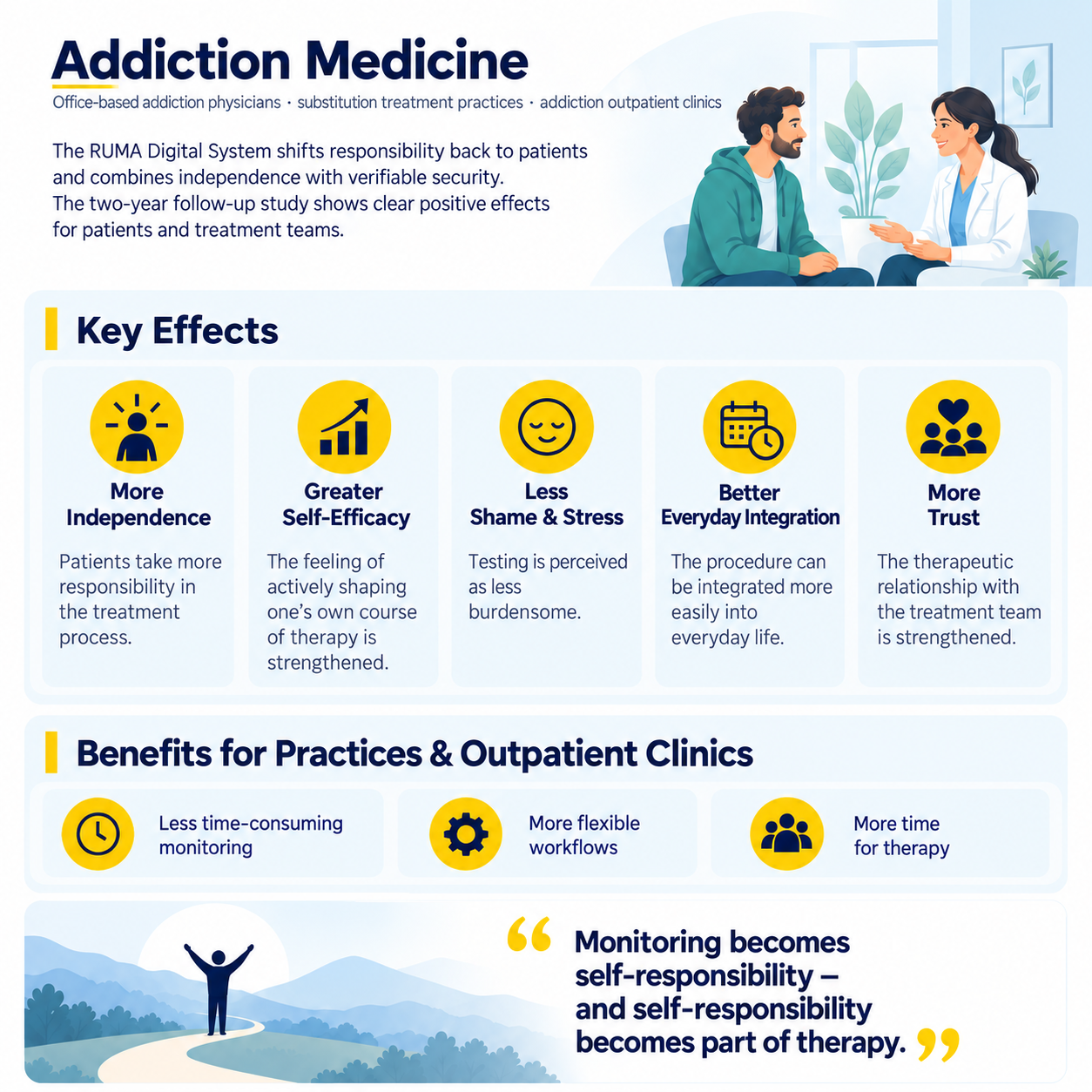
Patients Take Responsibility. Healthcare Professionals Gain More Time for Treatment.
The RUMA Digital-System enables verifiable evidence of compliance, giving patients greater independence and responsibility within their treatment without compromising security or necessary verification.
Patients carry out the prescribed procedure independently within the framework established by their healthcare professionals. This active participation was particularly emphasised in the two-year follow-up study: participants reported greater independence, self-determination and personal autonomy.
This also changes the role of supervision:
Moving away from exclusively externally imposed monitoring towards demonstrable personal responsibility.
The long-term findings highlight several benefits of particular relevance to addiction treatment:
- Greater independence and self-efficacy
- Stronger personal responsibility for the course of treatment
- Better integration of verification procedures into everyday life
- Less shame, nervousness and psychological distress
- Greater trust between patients and their treatment teams
- Support for adherence and commitment to abstinence
- Substantial time savings through reduced travel and waiting times
- Relief for healthcare professionals from time-consuming direct supervision
The study also found significant improvements in psychosocial measures over the two-year period. Stigmatisation, coping with everyday life, trust in physicians and willingness to recommend the procedure all developed significantly positively.
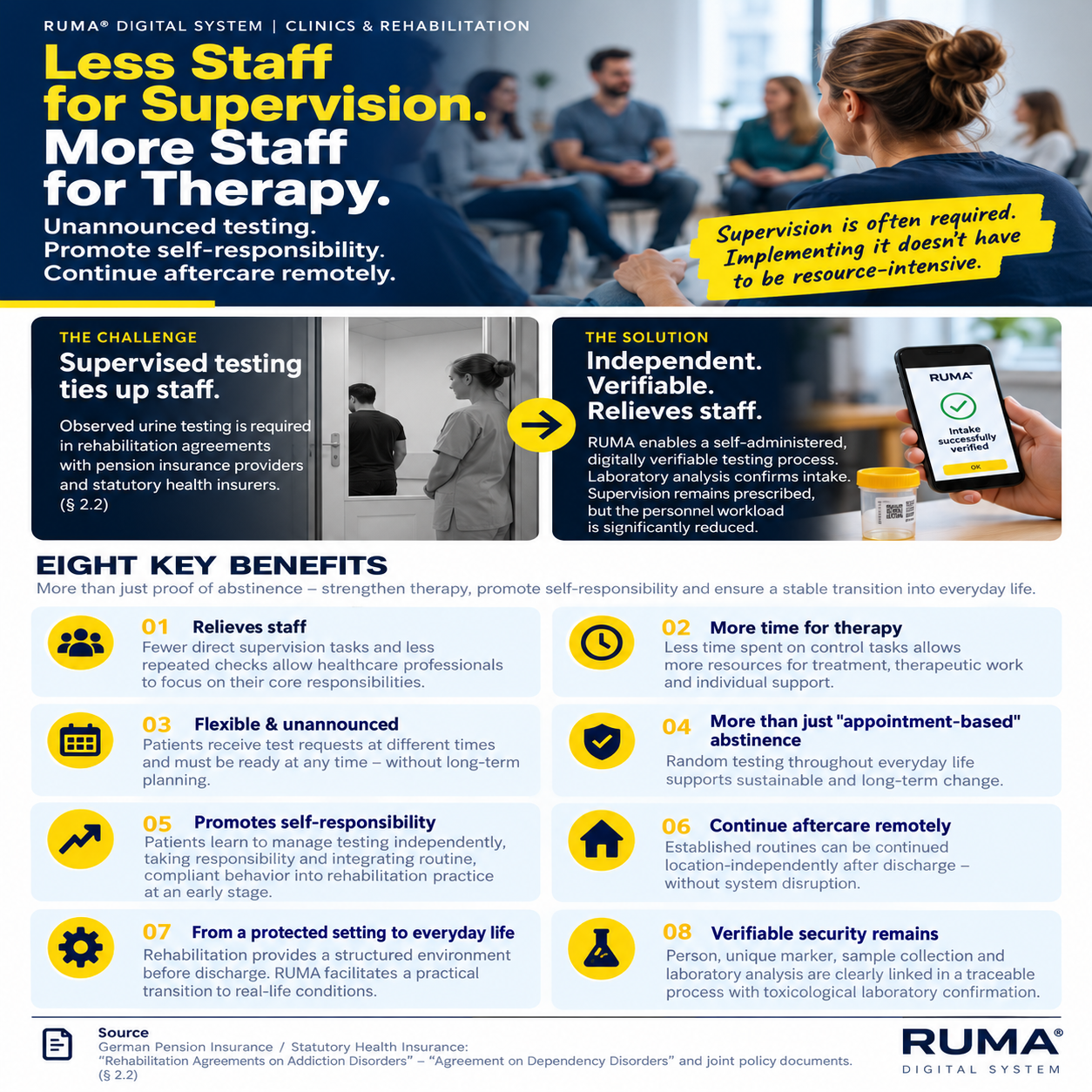
Less Staff Time Spent on Supervision. More Time for Treatment.
Unannounced testing. Building independence. Continuing follow-up care remotely.
Directly observed specimen collection ties up the very professionals needed for treatment and patient care in rehabilitation facilities. RUMA transfers verification into a process that patients can carry out independently and that can be verified afterwards – with the option of continuing the same process into follow-up care.
In addiction rehabilitation, abstinence and the absence of additional substance use must be reliably demonstrated. In Germany, the joint agreements between statutory pension insurance and statutory health insurance providers specifically envisage directly observed urine testing for this purpose.
RUMA does not change the need for verification – it changes how many staff resources must be devoted to it.
Patients carry out the required procedure independently. The facility defines the framework and time windows. Verification is based on the documented procedure and the laboratory specimen.
Key Benefits
- Reduced staff workload – less direct observation and fewer purely supervisory tasks.
- More time for treatment – healthcare professionals can focus on the work for which they are most needed.
- Short-notice and unannounced testing – patients must be prepared to provide evidence within a defined time window whenever requested.
- Abstinence beyond scheduled appointments – readiness for testing becomes part of everyday life.
- Practising independence before discharge – patients develop personal responsibility during rehabilitation.
- Seamless remote follow-up care – the same process can continue independently of location after discharge.
- Better integration into everyday life – preparing the transition from a protected environment to real-life conditions.
- Verifiable security is maintained – the individual, the procedure and the laboratory specimen remain reliably linked.
Rehabilitation ends. Reliable support doesn't have to.
Source: German Statutory Pension Insurance / Statutory Health Insurance, Joint Agreements on Addiction Treatment.
